

ABSCESS
We help you understand, treat and prevent abscesses in horses using natural ozone-based treatment protocols.

Understanding abscesses
An abscess is a localized pocket of infection containing pus, resulting from the body's natural reaction to isolate and eliminate pathogens (bacteria, fungi, or debris).
In horses, abscesses frequently appear on the feet (sole, frog, bulbs, periople), but can also develop on the skin or in the mucous membranes (mouth, trough, corners of the mouth).
Ozone, thanks to its oxidizing, antiseptic, and stimulating properties, helps to:
- to mature the abscess by activating microcirculation,
- to promote its natural release
- then thoroughly clean the cavity without using chemicals or irritants.

Foot abscess
Horse foot abscesses are particularly painful.
The horse often becomes lame, the hoof is hot, sometimes with a marked digital pulse.
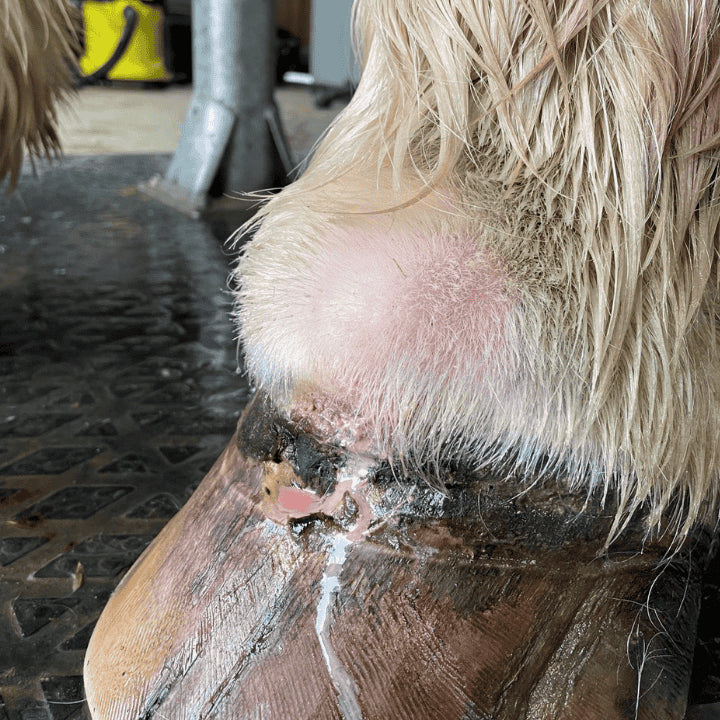
The abscess can rupture in three places:
- the periople ,
- the bulbs ,
- or the fork .
Ozone helps to accelerate maturation, facilitates removal and completely sanitizes the cavity after drainage.

Other abscesses (mouth, trough, etc.)
Skin or mucous abscesses (lips, mouth, trough, corners of the mouth) require a gentle approach that respects sensitive tissues.
Saturated ozonated oil is ideal here: it acts deeply, without irritating or burning the mucous membranes.
Natural treatment protocol for abscesses

Before

After
Before/After treatment protocol
With ozone, abscesses drain more quickly, the cavity is cleaned painlessly, and tissue regeneration is faster.
The skin or horn regains a healthy, clean and supple appearance.
Ozone stimulates the maturation and natural release of the abscess.
Ozone Super Guard acts as a natural antiseptic and healing agent.
No other disinfectant is needed.
Ozonated oil binds on its own and acts deeply.


FAQ ABOUT ABSCESSES
General Information
Protocol
Natural skincare products
Why does an abscess appear?
Due to a localized infection or a foreign body trapped in the foot or soft tissues.
Is it painful?
Yes, until the sac ruptures and the pressure decreases.
Should we have the vet or the farrier come?
In cases of severe pain, diagnostic uncertainty, fever, significant swelling, or abnormal progression, it is recommended to consult a veterinarian. The farrier or hoof care specialist can also help locate and drain the abscess.
Can an abscess recur?
Yes, especially if the underlying cause is not corrected: chronic moisture, degraded frog, hoof imbalance, persistent bacterial contamination, or weak horn.
How long does an abscess last?
It depends on its depth, location, and the quality of the drainage. Some abscesses develop rapidly within a few days, while others may require several weeks of care.
Can an abscess burst on its own?
Yes. The abscess can find an exit route through the sole, the frog, the bulbs, or sometimes the coronary band. However, as long as the drainage is insufficient, the pain may persist.
How to recognize a foot abscess?
Common signs are: sudden lameness, heat in the hoof, strong digital pulse, sensitivity to hoof testers, sometimes swelling of the limb, blackish or foul-smelling discharge when the abscess breaks.
What is a hoof abscess in a horse?
An abscess is a buildup of pus caused by a bacterial infection in the foot. Bacteria often enter through a crack, a hoof crack, a weakened sole, or after an impact. The pressure created in the tissues causes significant pain and sometimes dramatic lameness.
Does ozone help to lance an abscess?
Yes, by stimulating circulation and promoting natural ripening.
Can it be cleaned with something other than lukewarm water?
No, only lukewarm water should be used before applying ozone.
Should ozonated oil be massaged into the skin?
No, it is self-adhesive and penetrates the tissues on its own.
Can gaseous ozone and ozonated oils be combined?
Yes, these approaches are complementary. Gaseous ozone acts quickly in deep and hard-to-reach areas, while ozonated oils prolong the action over time in contact with tissues.
Does humidity promote complications?
Yes. Excessive moisture weakens the horn and promotes bacterial growth. Keeping the hoof clean and managing the environment is important during the care phase.
How long should the protocol be continued?
The duration depends on the age of the abscess, the quality of the drainage, and the general condition of the hoof. A personalized protocol is often preferable as each case is unique.
Why continue treatment after lameness improves?
Even when the pain subsides, bacteria may still be present in the deep tissues. Continuing the protocol helps limit recurrences.
Can ozone be used before the abscess ruptures?
Yes, the Intensive Ozone Treatment can be used beforehand to help sanitize the area and support the natural evacuation process.
What should I do when an abscess has just burst?
It is important to continue post-piercing care to clean the cavity, limit external contamination, and support tissue reconstruction. The use of Bagging is recommended for abscesses on a limb. Otherwise, use Intensive Ozone Care.
Why is it important to drain an abscess?
Drainage allows the evacuation of accumulated pus, bacteria, and inflammatory tissue. As long as this pressure remains trapped within the foot, pain and inflammation will persist.
What products should be used to treat abscesses?
To treat abscesses, you must use natural treatments 067: Ozone gas (bagging) and Ozone Super Guard.
Can Ozone Super Guard be used on mucous membranes?
Yes, it is perfectly tolerated and gently cleanses abscesses in the mouth or troughs.
Why is a customized protocol important?
Every abscess is different: depth, age, quality of the horn, environment, presence of rotten frog or associated thrush… Adapting the care often leads to better results. For a personalized protocol, contact me.
Do ozonated oils soften calluses?
When used correctly, they are mainly intended to support the foot's tissues and microbiological balance. However, the protocol must be adapted to each situation.
Can ozonated treatments be used on an open wound after drainage?
Yes, after drainage, ozonated care can help sanitize the area and support tissue repair. Use Intensive Ozone Care.
Do natural remedies always replace veterinary care?
No. A significant abscess, a deep infection, or a complication must be evaluated by a professional. Natural care is part of a holistic approach to foot care.
What is the difference between ozone gas and ozonated oil?
Gaseous ozone diffuses rapidly into cavities and deep areas. Ozonated oil acts more slowly but more sustainably upon contact with tissues. Their combination is often beneficial in chronic or deep cases.
Can Ozone Intensive Care be used on mucous membranes?
Yes, the Ozone Soin Intensif formula is suitable for sensitive areas and can be used on mucous membranes as needed for the treatment.
Why use ozonated oils on an abscess?
Ozonated oils provide prolonged action upon contact with tissues. Intensive Care Ozone helps maintain an unfavorable environment for microorganisms while supporting weakened skin and horn.
What products should I use for a foot abscess?
Treatment should aim for several goals: sanitizing the area, supporting drainage, protecting tissues, limiting moisture and contamination, and assisting in foot reconstruction. Bagging and Ozone intensive care are perfectly suited.